


 BUY NOW AND GET FREE SHIPPING
On all orders over 500,- (DK only)
BUY NOW AND GET FREE SHIPPING
On all orders over 500,- (DK only)
 1-2 DELIVERY DAYS
Order before 12 noon and we will ship the same business day
1-2 DELIVERY DAYS
Order before 12 noon and we will ship the same business day
 14 DAY RETURN RIGHT


Couldn't load pickup availability
18 in stock : 1-2 weekdays


Free shipping on orders over 500 DKK in DK

Ships from Roskilde DK

Local service center in Roskilde

1 year warranty

Customer Service
Email: hello@3dsaga.com
Phone: +45 69 15 31 11
All weekdays from 10:00 - 15:00
Showroom:
Monday - Thursday: 09:30 – 15:30
Friday: 09:30 – 15:00



Bamboo Lab ASA
Product features
-
Extraordinary UV resistance
-
Exceptional temperature resistance
-
High impact strength and durability
-
Suitable for long-term outdoor use
-
Comes with high temperature reusable coil
-
Diameter: 1.75mm ± 0.03mm
Caution when using
-
Compatible with AMS
-
Not compatible with AMS Lite
-
Requires embedded printers

Bamboo ASA
Bambu ASA is a highly durable material that offers exceptional UV, weather, mechanical and thermal resistance. Its unique combination of properties makes it an ideal material for printing outdoor models (plant signs, mailboxes, weather pennants, etc.) as well as structural parts exposed to long-term and demanding outdoor conditions.

Extraordinary weather and UV resistance
Bambu ASA offers exceptional resistance to UV radiation, oxidation and ageing, providing effective protection against breakage and colour deterioration in long-term outdoor use.

Tough and durable
Suitable for outdoor applications and general structural requirements thanks to the material's toughness and high impact strength.

Better temperature resistance
Compared to regular PETG or ABS, Bambu ASA retains its shape even at temperatures up to 100°C.

Frequently Asked Questions
- What is the difference between ABS and ASA?
| ABS | ASA |
|---|---|
| Composition: acrylonitrile – butadiene – styrene | Composition: acrylonitrile – styrene – acrylate |
ASA is a modified version of ABS, which contains an additional acrylate component that improves the material's weather resistance and UV resistance.
ASA retains the impact strength and processing properties of ABS, but has better resistance to fading, yellowing, and degradation when exposed to sunlight. Both materials can emit a pungent and unpleasant odor during printing, but the odor from ASA is noticeably milder than that from ABS.
2. What is the difference in applications for ABS and ASA?
ASA is ideal for outdoor applications – such as exterior car parts, signs and outdoor equipment – thanks to its improved weather resistance and color stability. ABS is a versatile material with excellent mechanical properties and is typically used for indoor applications.
3. What are the similarities between ABS and ASA?
Both materials have good impact resistance and high tensile strength with almost the same level of strength, toughness and stiffness. Both ABS and ASA can emit a pungent and unpleasant odor during printing, and both are prone to warping when printing large and/or high infill density models, and require a closed printer cabinet for this type of printing.
Comparison of parameters
See more filament comparisons in the Bambu Filament Guide >>
| ABS | ASA | PC |
|---|---|---|
| Price/kg: $27.99 | Price/kg: $29.99 | Price/kg: $39.99 |
| Composition: acrylonitrile – butadiene – styrene | Composition: acrylonitrile – styrene – acrylate | Composition: Polycarbonate |
| Hotend compatibility: Hotend with hardened steel nozzle 0.4 mmHotend with stainless steel nozzle 0.4 mm | All sizes / all materials | All sizes / all materials |
| Compatible build plates: Smooth PEI plate, textured PEI plate | Smooth PEI sheet, textured PEI sheet | Smooth PEI sheet, textured PEI sheet |
| AMS compatibility: Yes | Yes | Yes |
| Glue: Bamboo liquid glue/glue stick | Bamboo liquid glue/glue stick | Glue stick |
| Drying before use: Recommended | Recommended | Required |
| Odor during printing: Pungent/pungent odor | Relatively milder pungent odor | Slight phenolic aromatic odor |
| Toughness (impact strength – XY): 39.3 kJ/m² | 41.0 kJ/m² | 34.8 kJ/m² |
| Strength (flexural strength – XY): 62 MPa | 65 MPa | 108 MPa |
| Stiffness (flexural modulus – XY): 1880 MPa | 1920 MPa | 2310 MPa |
| Layer adhesion (impact strength – Z): 7.4 kJ/m² | 4.9 kJ/m² | 9.0 kJ/m² |
| Heat resistance (HDT, 0.45 MPa): 87℃ | 100℃ | 117℃ |
| Water absorption in saturated state / % (25 °C, 55 % RH): 0.65 % | 0.45% | 0.25% |
| Water absorption at saturation / % (25 °C, 55 % RH): 0.65 % | 0.45% | 0.25% |
| Max. water absorption rate / % (25 °C, 55 % RH): 0.65 % | 0.45% | 0.25% |
Accessory compatibility
| Recommended | Not recommended | |
|---|---|---|
| Building board | Smooth PEI sheet, textured PEI sheet | Cool Plate, SuperTack |
| Hotend | Hotend with hardened steel nozzle 0.4 mmHotend with stainless steel nozzle 0.4 mm | Hotend with hardened steel nozzle 0.6 mm / 0.8 mmHotend with stainless steel nozzle 0.2 mm |
| Glue | Bamboo liquid glueGlue stick | – |
ASA Hex Code Table
| Color | Hex Code | Display |
| White | #FFFAF2 | |
| Gray | #8A949E | |
| Save | #E02928 | |
| Green | #00A6A0 | |
| Blue | #2140B4 | |
| Black | #000000 |
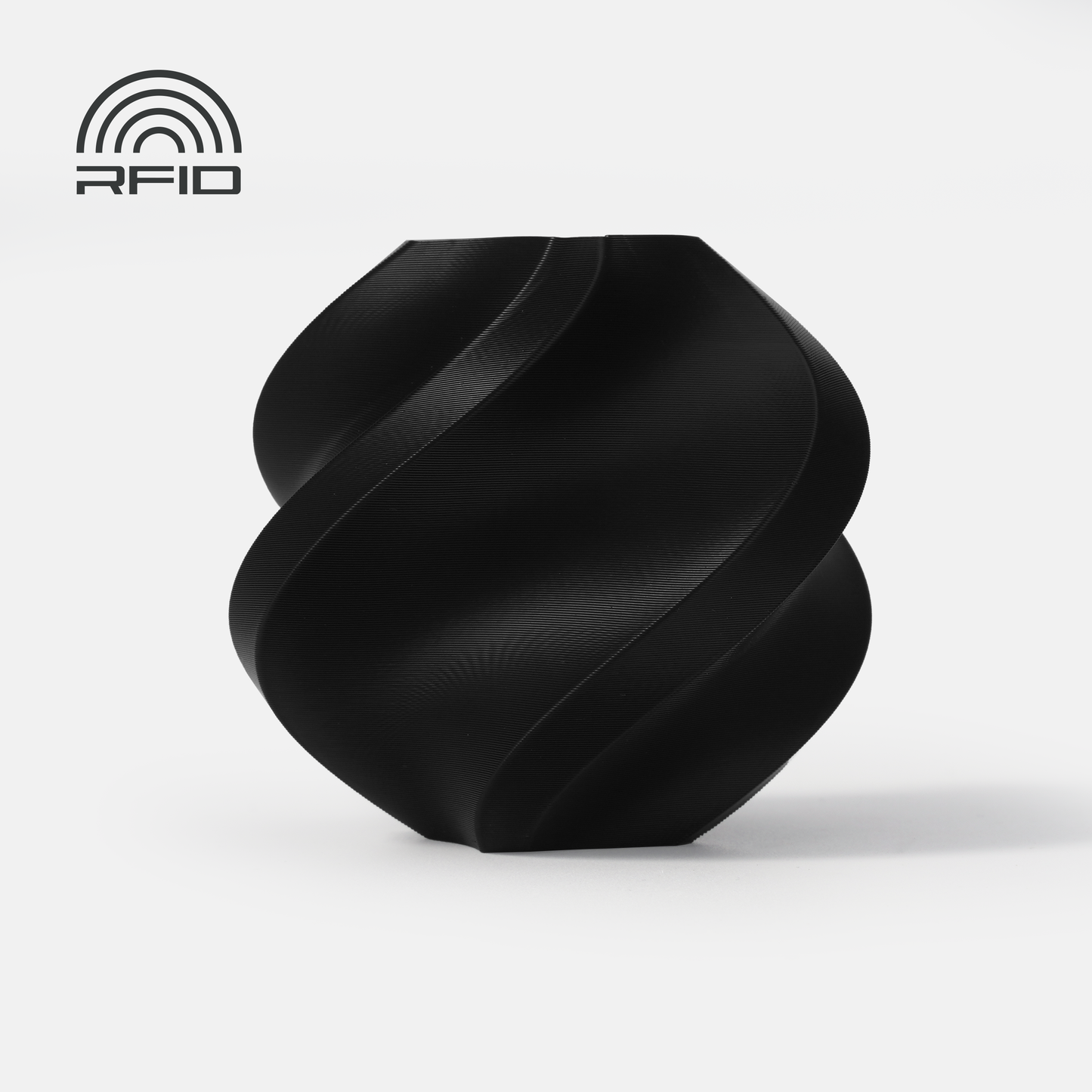
RFID for intelligent printing
All printing parameters are embedded in the RFID chip and can be read automatically via AMS (Automatic Material System).
Just plug and print! No more time-consuming settings or complicated setup steps.

Recommended print settings
| Setting | Value (Danish translation) |
|---|---|
| Drying settings (hot air drying oven) | 80°C, 8 hours |
| Humidity in storage and printing container | < 20% RH (sealed with desiccant) |
| Nozzle temperature | 240 – 270 °C |
| Plate temperature (with glue) | 80 – 100 °C |
| Print speed | < 250 mm/s |
Physical properties
| Property | Value |
|---|---|
| Density | 1.05 g/cm³ |
| Vicat softening temperature | 106 °C |
| Heat Deformation Temperature (HDT) | 100°C |
| Melting temperature | 210 °C |
| Melt Index | 7.0 ± 0.8 g/10 min |
Mechanical properties
| Property | Value |
|---|---|
| Tensile Strength | 37 ± 3 MPa |
| Elongation at break | 9.2 ± 1.4% |
| Flexural modulus (stiffness) | 1920 ± 130 MPa |
| Bending strength | 65 ± 5 MPa |
| Impact Strength | 41.0 ± 2.3 kJ/m² |
Download
Printing tips
• A strong, unpleasant odor may be emitted during printing. Make sure the printer is in a well-ventilated area.
• Drying: 80°C for 8 hours. Store the filament in a dry environment after use. If the material has absorbed moisture, it should be dried before printing. Please see Filament drying instructions on WIKI for more details.
• ASA tends to warp when printing large-sized models and/or with high infill density.
To avoid warping:
-
It is not recommended to print too large models or with very high infill density.
-
Use a printer with an enclosure, and make sure the build plate has glue on it before you start printing.
-
Reduce print speed and increase bed temperature. See Common Print Quality Issues and Solutions on WIKI for more details.
What's in the package?
