


 BUY NOW AND GET FREE SHIPPING
On all orders over 500,- (DK only)
BUY NOW AND GET FREE SHIPPING
On all orders over 500,- (DK only)
 1-2 DELIVERY DAYS
Order before 12 noon and we will ship the same business day
1-2 DELIVERY DAYS
Order before 12 noon and we will ship the same business day
 14 DAY RETURN RIGHT


Couldn't load pickup availability
20+ in stock : 1-2 weekdays


Free shipping on orders over 500 DKK in DK

Ships from Roskilde DK

Local service center in Roskilde

1 year warranty

Customer Service
Email: hello@3dsaga.com
Phone: +45 69 15 31 11
All weekdays from 10:00 - 15:00
Showroom:
Monday - Thursday: 09:30 – 15:30
Friday: 09:30 – 15:00


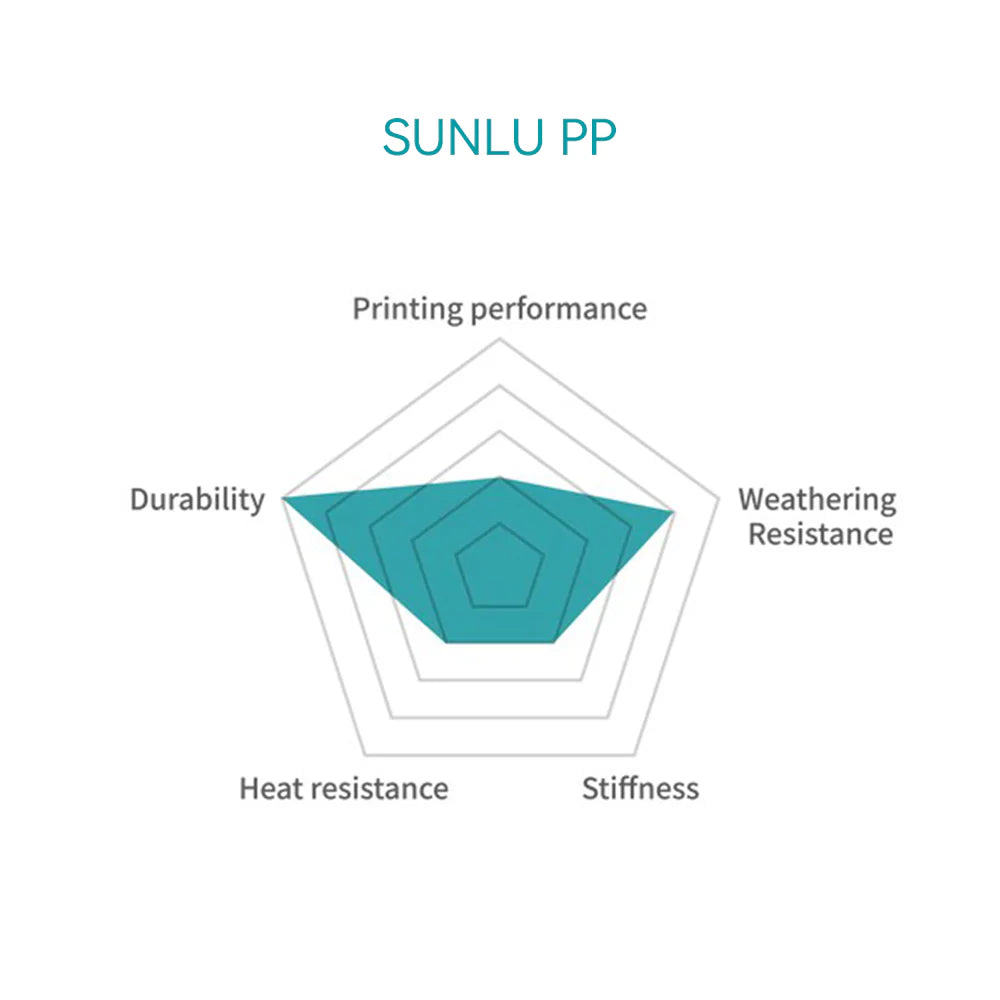
Sunlu PP (Polypropylene)
Key Features
Lightweight yet strong PP material
Up to 27% lighter than PLA, producing strong and functional parts with reduced material consumption.
Food-safe & chemical-resistant
Suitable for containers and kitchen utensils, with excellent resistance to acids, bases, and solvents.
Tough, flexible & fatigue-resistant
High impact strength and elasticity for durable parts that can withstand repeated stress.
Diameter: 1.75 ± 0.03 mm
Print Temperature:
260–280 °C: 50–230 mm/s
Build Plate Temperature:
50–60 °C: apply PC adhesive
Bubbles: 100% bubble-free
Net Weight: 1 kg/spool
Gross Weight: 1.3 kg/spool
Length: 1.75 mm (1 kg) ≈ 385 m

SUNLU PP Filament
SUNLU PP filament combines low weight with exceptional toughness and chemical resistance. Up to 27% lighter than PLA, it produces strong yet flexible parts with reduced material consumption. With food-grade certification, excellent resistance to acids and solvents, and high fatigue resistance, it is ideal for functional everyday and industrial applications where safety, longevity, and reliable performance are crucial.

The printed part is lightweight (PLA has a density of approx. 1.23 g/cm³, while PP has a density of approx. 0.9 g/cm³), making it about 27% lighter. SUNLU PP filament creates lightweight yet strong parts and helps reduce material consumption without compromising performance – ideal for functional prints and everyday projects.

SUNLU PP filament is approved for food contact and suitable for printing containers, kitchen utensils, storage boxes, and other applications where safety and reliability are important.

SUNLU PP filament is developed with superior chemical corrosion resistance. Polypropylene filament resists the effects of acids, bases, and solvents, ensuring stability and long-lasting performance in demanding environments.

With exceptional toughness, elasticity, and fracture strength, SUNLU PP 3D printer filament offers high impact strength and flexibility, making it perfect for durable and stress-resistant parts.

Printing Tips
To ensure optimal first-layer adhesion, use a print surface specifically designed for PP materials. Apply PP adhesive, set the fan to max 10%, and print in an enclosed chamber to minimize warping. To improve adhesion between print and build plate, it is recommended to add skirt structures around the object. To avoid deformation caused by PP material crystallization, avoid dense and rectangular infill patterns.


Recommended Print Settings
| Setting | Value |
|---|---|
| Drying (hot air oven) | 50–60 °C |
| Humidity in print and storage container | < 20% RH (sealed, with desiccant) |
| Nozzle temperature | 210–230 °C (50–150 mm/s) |
| Build plate temperature (with PP adhesive) | 50–60 °C |
| Print speed | 50–150 mm/s |
Physical Properties
| Property | Value |
|---|---|
| Density | 0.9 g/cm³ |
| Vicat softening temperature | / |
| Heat deflection temperature | 61 °C |
| Melting temperature | 156 °C |
| Melt index | 9 g/10 min |
Mechanical Properties
| Property | Value |
|---|---|
| Tensile strength | 22.7 MPa |
| Elongation at break | 900% |
| Flexural strength | 24 MPa |
| Flexural modulus | / |
| Impact strength (X-Y) | 40 kJ/m² |
Download product information


